
Washington County Parole and Probation
Parole and probation both allow community supervision, but they start in different ways. The Missouri Parole Board acts within its statutory authority when it grants or sets parole for an eligible state prisoner. Probation is ordered by a court, often instead of all or part of a prison term. The Missouri Department of Corrections Division of Probation and Parole supervises eligible people in both groups. A person released from Washington County Jail on bond may have court release terms, yet that alone does not make the person a DOC probationer or parolee.
The custody source controls the check. A Washington County Jail booking and release entry is the right local record for a bond or time-served release. A person leaving Potosi Correctional Center on parole or conditional release remains in the state system. The MODOC Offender Search covers active offenders, including active probationers and parolees, but expressly excludes people who have been finally discharged. Thus, a result can help confirm current supervision. A blank result cannot prove that supervision never existed or that a release occurred.
| Point | Parole | Probation |
|---|---|---|
| How it begins | Parole Board action after a prison sentence | Court order in a criminal case |
| Custody before supervision | Usually state prison | May begin without a prison release |
| Primary public context | MODOC status, board action, field office | Court docket, MODOC status, field office |
| How it ends | Final discharge or other lawful termination | Discharge, completion, revocation, or other court/DOC action |
- Parole
- Supervised community release from a state prison term under Parole Board authority.
- Probation
- Court-ordered supervision in the community, which may occur without a prison release.
- Conditional release
- A supervised part of a Missouri sentence structured by law; it is not final discharge.
- Discharge
- The formal end of supervision or DOC legal custody, not just the day a person leaves prison.
Check Washington County Supervision Status
Use a name plus a DOC number when that number is known. A DOC number is less likely than a name to match the wrong person. The public system is an active-status tool with a data timestamp, not a live report from a jail door. Read each displayed status exactly. Then use the state office directory and the court record to test what that status means in the Washington County case.
- Search the person in the official MODOC Offender Search. Compare the full name, DOC identifier, date of birth, and any other public identifiers shown.
- Determine whether the result describes prison custody, probation, parole, or another active DOC status. Do not convert a no-result into proof of discharge.
- Use the current probation and parole address listing to identify the office tied to the release plan. The office nearest the county is not always the assigned office.
- For probation created by a Washington County judgment, compare the result with Case.net and the correct docket. A court order and an active DOC label answer different parts of the question.
- Ask the assigned office only for public, status-level confirmation. Protected case details do not become public merely because the caller knows the person’s name.
When the active search is missing or unclear, DOC directs general search questions to Offender Inquiry and Constituent Services. Its official contact route asks for the correctly spelled full name and, when available, the DOC number and date of birth. Specific release-date and home-plan issues go to the institutional caseworker or parole office. A former DOC subject who has reached final discharge instead requires the DOC Sunshine historical dataset or a focused records request.
Note: A Washington County jail release record confirms the local custody event; it does not by itself establish state parole or probation.
Washington County Supervision Office Details
The current state directory identifies District 15S Potosi Probation and Parole as the concrete local contact for a release plan assigned in the Washington County area. Older indexed pages may show a different district number. Use the live directory. Location alone is not proof of assignment, since supervision may follow the approved home plan and the office named in the offender record.
District 15S Potosi Probation and Parole23 Southtowne Drive
Potosi, MO 63664
573-438-3448
The official directory is also the source for this local office image. Review the current District 15S listing before relying on an office number saved elsewhere.
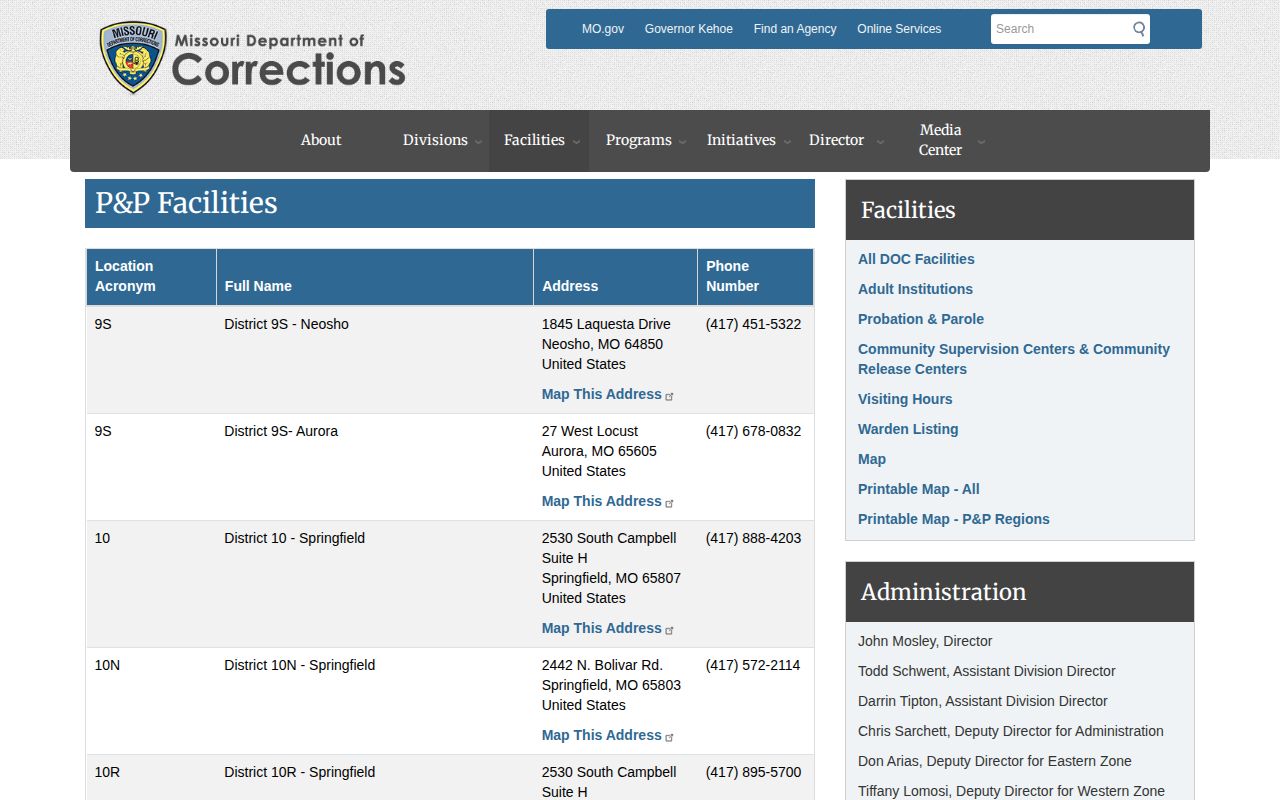
The listing anchors Washington County post-release supervision to a verified local channel while leaving the case-specific assignment for DOC to confirm.
Washington County Release Plans and Dates
A parole hearing is not the release itself. Missouri DOC’s Victim Services material says a hearing can lead to another hearing or a future date, and a board decision normally takes time to issue. Even a favorable setting may still turn on conduct, required programming, and an acceptable home plan. The exact board notice and institutional record control. A calendar estimate should never replace them.
The board and the field office also answer different questions. The board decides parole matters within its authority. The institution works with the proposed plan before release. Once community supervision begins, the assigned probation and parole office manages the public status and case-level supervision. Calling District 15S before confirming assignment can yield no useful answer, even when the proposed home is in Washington County.
For someone still at Potosi Correctional Center, questions about a specific date or home plan belong with the institutional caseworker or parole office. District 15S handles community supervision when it is the assigned field office, but it does not calculate every PCC release at the front desk. The Missouri Parole Board has general authority under section 217.690, and exclusions or special sentence rules make a universal eligibility formula unsafe.
A court release from Washington County Jail follows a different path. The sheriff’s dated release entry and the Washington County court docket show whether the person left on bond, completed a local sentence, received probation, or transferred. The Washington County Circuit Clerk maintains electronic proceedings for the local circuit, but a docket entry authorizing release may precede physical processing. The broader Washington County released-inmate search and record path addresses that custody event.
Washington County Absconder and Warrant Status
An absconder label means the supervising agency alleges that the person stopped complying or communicating as required. It is a supervision status, not permission for a member of the public to approach or detain anyone. Verify a warrant with the issuing court or law-enforcement agency. Case.net may supply a docket entry, but a current warrant check should come from the authority responsible for it.
Violation reports can lead to added review, custody, suspension, or revocation proceedings. The public status does not disclose every fact behind a case. A missed appointment, an alleged new offense, a move without approval, or another claimed breach can require formal agency or court action before the result is final. VINELink can provide custody-event alerts when the relevant agency participates, but it is not a full supervision history or warrant database.
Note: A transfer into custody after a supervision issue is not the same event as final discharge from Washington County post-release supervision.
When Washington County Supervision Ends
Leaving prison and ending supervision are separate milestones. Missouri law allows eligible people on probation, parole, or conditional release to earn compliance credit for a full compliant calendar month. Under section 217.703, qualifying credit is 30 days for that month, but it does not accrue during defined violation, absconder, custody, or pending revocation periods. The credit affects community supervision. It is not county-jail good time and should not be used to calculate a prison-door date.
The DOC early-discharge information and section 217.730 describe routes to a final order or certificate. Once final discharge occurs, the active MODOC search will not return the person because it excludes discharged offenders. That absence is expected, yet it still does not prove discharge on its own. Use the DOC historical Sunshine data, a targeted request for the discharge event, or a lawfully held discharge certificate.
A focused DOC request should name the person, DOC number when known, and the exact event sought. Ask for the releasable supervision status, final discharge date, or certificate information rather than an undefined “release record.” DOC’s Sunshine data includes people currently or formerly under its authority, with records reaching back decades, but the bulk file may contain more than one charge row and may not reflect a change at once. Read its field definitions before drawing a timeline.
Different records should remain separate. The sheriff keeps the Washington County jail release or transfer event. Case.net preserves available court orders and docket history. MODOC maintains state custody and supervision records. A final check names the exact event, its date, and the agency that created it. Keep the date, source label, and custodian together in any personal notes. That method avoids calling parole a completed sentence, probation a prison release, or transfer a return to the community.